Speaker
Description
Mechanisms of destabilization of toroidal Alfvèn eigenmodes (TAE) in tokamaks are analyzed with the aim to reveal those leading to modes propagating in the direction opposite to plasma current, i.e. counter-propagating modes (ctr-TAE). Plasmas with fast-ions sources [such as neutral beam injection (NBI), ion cyclotron resonance heating (ICRH), fusion reactions] and without them (Ohmic discharges) are considered. A particular NSTX-U experiment with NBI, where co- and counter-propagating TAEs were observed simultaneously [1], is considered.
This presentation is based on the recent publication [2] which is extended to take into account finite width of the pitch distribution of the beam particles.
It was assumed in Ref. [2] that the pitch distribution of fast ions is approximated by the Dirac $\delta$-function, $F_\alpha\sim\delta(\chi-\chi_0)$, where $\chi=v_\|/v$, $v$ is the particle velocity, $v_\|$ is the velocity along the magnetic field. This approximation was justified by the fact that the dependence of the fast ion distribution on $\chi$ was not known. At the same time, it remained unclear whether finite width of distribution over $\chi$ does not stabilize the instability. In order to clarify this issue, the relations used in Ref. [2], which describe the instability growth rate, $\gamma(\chi)$, were extended by taking into account the presence of fast ions with various pitches, $\Delta\chi\neq0$. The numerical code calculating the growth rate was changed correspondingly. Calculations for both ctr-TAEs and co-TAEs were carried out for the cases when the fast ion density, $n_\alpha(r)$, has a plateau or a weak maximum, as shown in Fig. 4 of Ref. [2].
The results of calculations for two found ctr-TAE are shown in Fig. 1. We observe that finite $\Delta\chi$ decreases the growth rate, and can even completely suppress the instability (Fig. 1, left panel; when $\Delta\chi=0.2$, low mode is stable at $x_\max=0.35$ but unstable when the plateau is slightly extended, $x_\max=0.4$). On the other hand, it is a bit surprising that in some cases, when $\Delta\chi\neq0$, fast ions with pitches which are stabilizing for $F_\alpha\sim\delta(\chi-\chi_0)$ can become destabilizing (Fig. 1, left panel; the stable region of high mode at $\chi_0>0.75$ becomes unstable). This is explained by the fact that the positive derivative $\partial F_\alpha/\partial\chi>0$ shifts to smaller $\chi$ due to $\Delta\chi\neq0$.
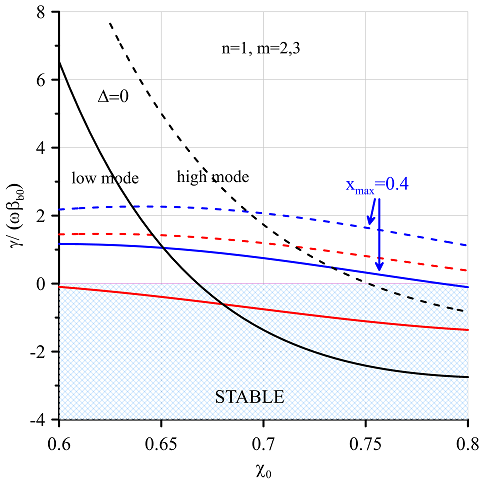
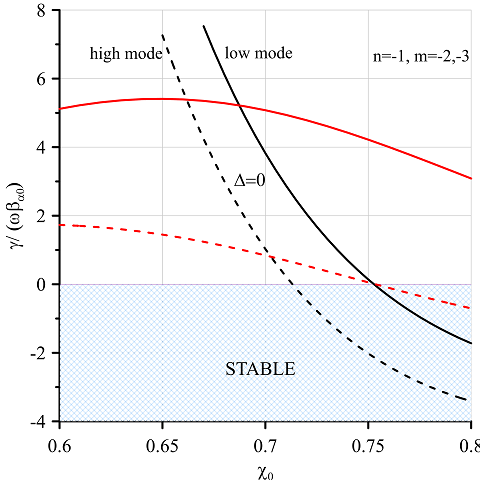
Fig. 1. $\gamma$ versus $\chi_0$ for ctr-TAE in the NSTX-U discharge #205072 when $F_\alpha=n_\alpha(x)(v^3+v_c^3)^{-1}\exp[-(\chi-\chi_0)^2/\Delta\chi^2]$, with $x=r/a$: Left/top panel, $n_\alpha(x)$ with a plateau in the region $[0, x_\max]$, $x_\max=0.35$ except where noted $x_\max=0.4$. Right/bottom panel, $n_\alpha(x)$ with a maximum at $x_\max=0.35$.
[1] Podestà M., Fredrickson E.D. and Gorelenkova M. 2018 Nucl. Fusion 58 082023
[2] Kolesnichenko Ya.I., Fredrickson E.D., Lutsenko V.V., Tykhyy A.V. 2026 Nucl. Fusion 66 046002