Speaker
Description
The Monte Carlo orbit-following code ASCOT /1/ is a widely used tool for simulating fast ion minority populations in toroidal devices, featuring source modules for fusion products (AFSI) and neutral beam injection (BBNBI) as well as modelling of ion cyclotron resonance heating (RFOF). In addition to its capability to simulate the formation of hot ion tail distributions from various sources in realistic plasma configurations, ASCOT’s main strength is its ability to model fast ion heat load distributions on experiment-specific plasma-facing components described by sets of triangles imported from stereolithography (STL) CAD data.
In the present work, ICRH simulations are made for ASDEX Upgrade discharge #42762 using ASCOT-RFOF with a new, detailed 3D wall mesh based on STL data for the four ICRF antenna limiters and Faraday screens, the four passive limiters, and the complete set of protection tiles for the upper and the lower magnetic perturbation coils.
In addition to the new wall model, a new postprocessing scheme is applied where the STL data describing a given plasma-facing component is refined by recursively splitting large triangles into smaller ones until a requested area per triangle is achieved. The recorded exact locations of fast ion marker hits are then mapped onto the refined mesh, demonstrating that, marker hit statistics permitting, ASCOT is able to simulate fast ion heat load patterns on an arbitrarily detailed mesh of any plasma-facing component (see Fig. 1).
For details of the thermo-mechanical analysis of the results and comparison to experimental observations, see the contribution of R. Ochoukov et al. in this Technical Meeting.
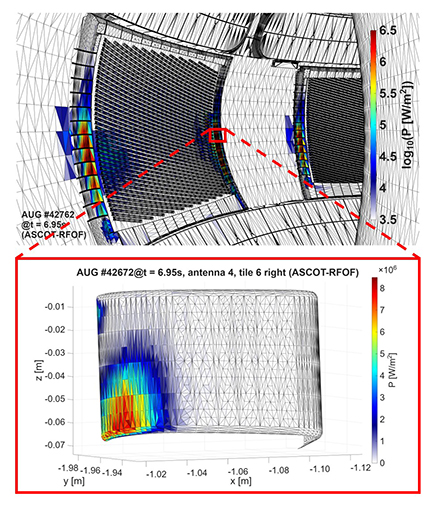
Figure 1. Top: fast ion load on antenna 4. Bottom: refined mesh and load on one limiter tile.
/1/ E. Hirvijoki et al., Comput. Phys. Commun. 185 (2014) 1310.