Speaker
Description
The Ion Cyclotron Emission (ICE) driven by NBI, ICRH, and fusion reactions was observed in many toroidal fusion devices and is well studied theoretically. Much less attention has been paid to the ICE in the tokamak Ohmic discharges. Although this ICE was first observed as long ago as in the 80’s [1], at present there is no clear understanding why it arises despite the absence of fast ion sources. This fact stimulated our presentation aimed to elucidate possible mechanisms driving waves with frequencies close to harmonics of the ion gyrofrequency in Ohmic discharges. Two destabilizing mechanisms will be presented at this EP meeting, and some estimates for the MAST-U experiment [2] will be done. The first mechanism is relevant to a plasma with a Maxwell velocity distribution. Another one is associated with the plasma current. Below we describe the results on the first issue, research on the second one is planned to be finalized in a couple of months. Part of our results is recently published in Ref.[3].
A new mechanism of destabilization of cyclotron waves responsible for the ICE is found; the known mechanism [4] - interaction between cyclotron waves and drift waves is shown to be hardly able to lead to instabilities in realistic tokamak plasmas. Our finding is that the resonance wave-particle interaction in the presence of temperature gradient can change the diamagnetic drift frequency in such a way that the destabilizing influence of the diamagnetic drift exceeds Landau damping. This occurs when the energy of resonance particles is sufficiently high, which is always the case due to the infinite tail of the Maxwell distribution. Particles with higher energies provide a larger ratio of drive to damping, but the number of resonance particles and, thus, instability growth rates are exponentially small when particle energy is very high. Therefore, only moderately suprathermal particles can lead to observable instabilities.
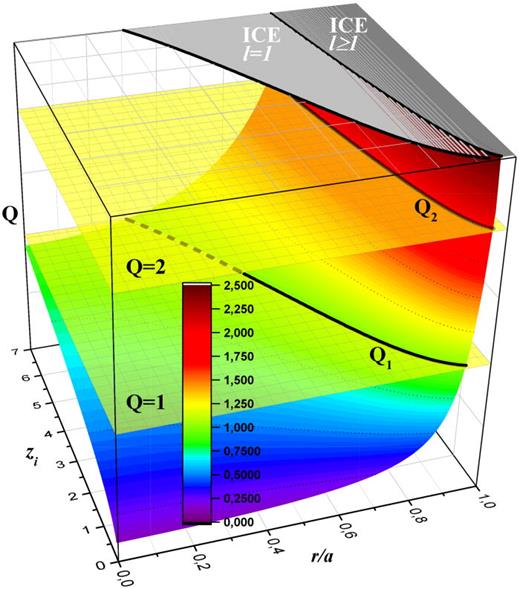
The ratio of drive to damping, $Q(r,z_i)$ with ${{z}_{i}}=k_{\bot }^{2}\rho _{i}^{2}$, strong text(color surface) and the region of possible ICE sources (gray hatched region in the plane on the top). $Q_1$ and $Q_2$ are the curves of intersection of the $Q=1$ and $Q=2$ yellow planes with the $Q(r,z_i)$ surface.
[1] W. H. M. Clark, “Measurement of emission in the ion cyclotron frequency range for Ohmic and ICRH discharges in TFR,” in Proceedings of Fourth International Symposium on Heating in Toroidal Plasma, Vol. 1, edited by H. Knoepfel and E. Sindoni, Rome, 1984, Vol.1, pp. 385–391.
[2] N.A. Crocker et al., “New experimental measurements of core ion cyclotron emission via Doppler backscattering in MAST-U Ohmic plasmas,” in 30th ITPA Topical Group meeting on Energetic Particle Physics (Culham 2023).
[3] Ya.I. Kolesnichenko, V.V. Lutsenko, A.V.Tykhyy, Phys. Plasmas 31, 042107 (2024)
[4] A.B. Mikhailovsky, Nuclear Fusion 5, 125–143 (1965).
Work was supported by Subaward #2022-1701 of the US DOE Grant DE-FG02-06ER54867 via STCU Project P786/UCI.
| Presentation type | Poster |
|---|